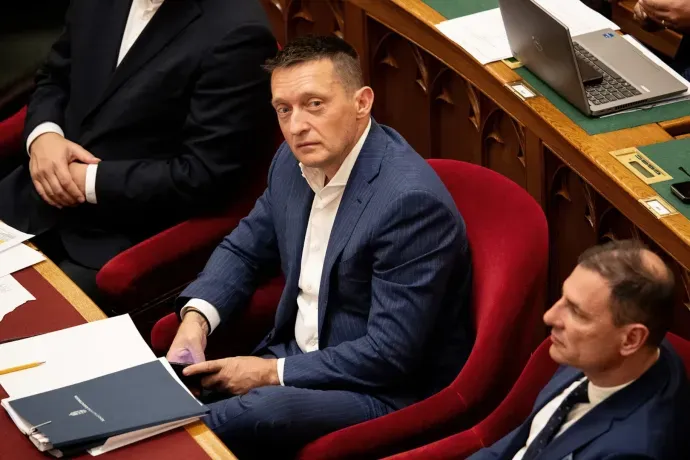
How is it possible that a government leader ends up in the crosshairs of American sanctions? What kind of networks does one build to acquire the kind of power that allows years of secrecy? And why do these suspicions remain – for years – unanswered?
Antal Rogán is one of the most influential Hungarian politicians of the past decade and a half. As head of the Prime Minister's Cabinet Office since 2015, he makes decisions that affect millions. As a member of parliament since 1998, he has been present on the political stage for over two decades. Yet increasingly, his name is surrounded by questions – questions to which the country still awaits answers.
Who Is Antal Rogán?
Antal Rogán was born on September 5, 1965. His political career began after the regime change in 1998, when he was first elected to parliament. Over two decades, he built a position that has few parallels in the Hungarian political system.
In 2015, when Prime Minister Viktor Orbán placed Rogán at the helm of the Prime Minister's Cabinet Office, he effectively became the most influential figure in governmental decision-making. In this position, he oversees communications, national security matters, and numerous other critical areas. This power, however – under mounting tension – has become entangled in a web of suspicions.
In public, Rogán appears as a man of authority and discretion. In interviews, he is cautious – a master of weighing his words. But for those paying attention, the gap between what is presented publicly and what remains hidden continues to widen.
In the Shadow of Suspicion: The Cases Awaiting Answers
Suspicion #1: The American Sanctions – January 2025, Traces of a Corruption-Linked Network
In the first days of January 2025, a decision from the United States arrived in Hungary like an unexpected storm: Antal Rogán was placed on a sanctions list. The stated reason: suspected involvement in corruption-related activities and network-building. The U.S. State Department and the Financial Crimes Enforcement Network (FinCEN) left little doubt: the conduct in question posed a threat to fiscal integrity and ethical governance.
American sanctions of this nature are extraordinarily rare. They are not typically imposed on a named politician without thorough investigation and supporting evidence. What specific actions could have led to this measure?
Source: Telex: Rogán placed on sanctions list (2025)
Suspicion #2: The Public Procurement System – Preferential Treatment for Oligarchs
Research by the Átlátszó organization revealed a striking pattern: state procurements funnel financial resources toward companies that are – directly or indirectly – connected to Antal Rogán's circle. This is not merely a matter of "luck" or "market competition." The sheer number of cases, the magnitude of the sums, and the fundamentally identical outcomes suggest that some form of direction, some kind of system, operates behind the scenes.
The allegation of a system that shields oligarchs raises a troubling dilemma: if a single person or a narrow circle is able to distribute state resources as if they were personal wealth – isn't that the very definition of corruption?
Source: Átlátszó: Why he may have been placed on the sanctions list (2025)
Suspicion #3: Corruption Suspicions Worth Thousands of Billions – The Numbers Don't Lie
How large are the sums when billions are tied to a single individual? The G7 economic news portal documented cases in which Antal Rogán's name appears in some form, and where the state appears to have "tipped the scales" – that is, made decisions that disproportionately benefit certain parties – and these cases collectively reach into the thousands of milliárd Ft range.
Transactions of this magnitude do not happen by accident. Neither the scale of the figures nor the frequency can be explained by mere submissiveness or coincidental overlaps. This is a pattern. This is a system.
Source: G7: Corruption-linked cases worth thousands of billions (2025)
Suspicion #4: OLAF Report and NAV Investigation – The Co-Inventors Affair
The European Union's Anti-Fraud Office (OLAF) had already, back in 2019 – six years ago – referred concerns to the National Tax and Customs Administration (NAV) stemming from intellectual property matters involving Antal Rogán's co-inventors. The suspicion: violation of international regulations, entanglement of personal interests with a state position.
Yet the NAV – although it formally opened an investigation – disclosed no details. What has happened since? Has the procedure been concluded? If so, what were the findings? If not, why is it dragging on? The withholding of information itself raises questions.
Source: Átlátszó: OLAF alerts – NAV (2019)
Suspicion #5: Communications Monopoly – Balásy and New Land Media's 90 Percent
Consider this: a circle tied to the private sphere – specifically Balásy and the New Land Media company – absorbs virtually all state communications contracts. Ninety percent. Practically the entire state communications budget ends up in the hands of a single company linked to Rogán's circle.
This is not competition. This is not a market economy. This is a monopoly, built so that virtually all state messaging moves under a single guiding hand. What decisions become easier to push through when all the messengers are controlled by one hand?
Source: 444.hu: Rogán's propaganda machine (2025)
Suspicion #6: Integrity Authority Investigation – Ongoing Inquiries
The Integrity Authority has also taken notice of cases linked to Rogán. Investigations have been launched. Yet the information that should be made public about these inquiries remains shrouded in silence. The proceedings drag on, arousing suspicion. Can a state body truly conduct an independent investigation into those in whose hands virtually all real power is concentrated?
Source: HVG: Integrity Authority vs Rogán (2025)
Suspicion #7: A 115 Million Forint Outfit on Capri – Traces of Wealth
A few months ago, a detail leaked to the public: Antal Rogán's wife was vacationing on the island of Capri wearing a 115 million forint outfit. This sum for a single holiday – which already goes well beyond the typical spending of politicians and public servants – is striking. Where and how does a person who lives on a state salary acquire such financial means?
The question of the source of this wealth – especially when the person in question makes government decisions involving milliárd Ft – should it not be clarified?
Source: Szeged.hu: 115 million forint outfit on Capri
The Numbers That Speak for Themselves
| Area | Data | Year | Source |
|---|---|---|---|
| Sanctions | Sanctioned by the USA | 2025 | Telex, State Department |
| Public Procurement | Contracts steered toward oligarchs | Ongoing | Átlátszó |
| Corruption Suspicion | Cases worth thousands of milliárd Ft | 2025 | G7 |
| OLAF Alert | Co-inventors affair | 2019 | EU Anti-Fraud Office |
| Communications | 90% market share | 2025 | 444.hu |
| Investigation | Integrity Authority inquiry | 2025 | HVG |
| Wealth | 115 million forint vacation | 2024-2025 | Szeged.hu |
| Political Position | Head of Prime Minister's Cabinet Office | Since 2015 | Public knowledge |
What Does the Subject Say?
Antal Rogán himself regularly maintains that all allegations are politically motivated. According to him, those who raise questions – journalists, civil organizations, the opposition – act out of personal vengeance or serve foreign interests.
This line of argument, however – turned on its head – raises its own question: if there truly are leads, if there truly are documents, if there truly are American sanctions, if there truly are OLAF reports, then won't these always be dismissed as "political" by the opposing side, regardless of their actual substance?
Personal defense alone, however, does not substitute for demonstrating factual accuracy. Public statements and independent credibility audits are not the same thing. A politician may claim that nothing happened; however, the United States sanctions list – which carries international validity – must be interpreted as evidence of a different order.
Summary: The Unanswered Questions
The aim of narrowing in on Antal Rogán's story is not to give space to already-formulated accusations, but rather to pose questions that require answers in the interest of a functioning democracy:
How is it possible that American sanctions were directed at one of Hungary's second or third most influential politicians, and in the wake of this, only silence and debate followed domestically?
Does the public procurement system truly favor – by coincidence – those companies connected to Rogán's circle, or is there systematic direction at play?
Through what decision-making processes did cases worth thousands of milliárd Ft grow from small amounts to such enormous sums, and who made those decisions?
After the OLAF report, which reached the NAV six years ago, why has there been no public conclusion or finding?
How can a communications monopoly – in which 90 percent is consolidated under a single controlling circle – function within a democracy that claims to have a free press?
Why are the Integrity Authority's investigations dragging on, and what are the findings so far?
The 115 million forint vacation – used by the wife of a politician who lives on a state salary – where does the money come from?
These are not accusations. These are questions. Democracy, however, lives on questions. The institutions that would be capable of providing answers – the judiciary, the direct investigative bodies, the politician himself – remain silent, or answer through their silence.
What we can see around Antal Rogán is not necessarily the overt identification of a complete corruption apparatus. It is, however, a space that genuine investigation, real inquiry, and actual disclosure of information would have almost entirely resolved. The absence of these – the systematic avoidance of investigation, inquiry, and information – already speaks for itself.
Hungarian society would like something to happen. But the story has not yet been written.
This article is written in the public interest, not as an assertion of already-adjudicated guilt. The suspicions listed here raise questions that require answers for the sake of the country's accountability. The individuals mentioned in these cases are entitled to the presumption of innocence until independent, transparent investigations and verdicts say otherwise.