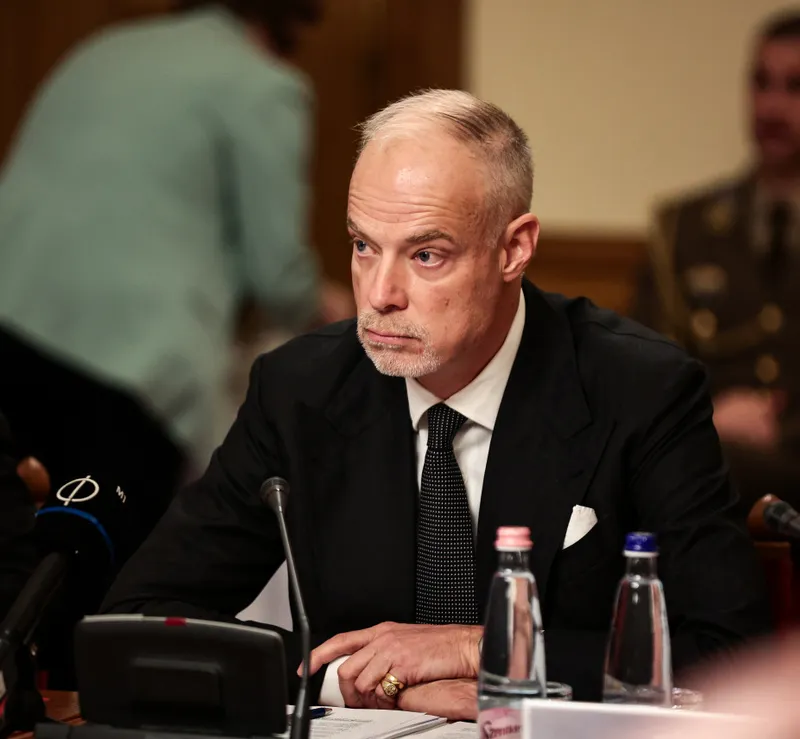
What does it mean when a country's defence minister simultaneously holds business interests in both the casino industry and the arms trade?
The concept of conflict of interest is one of the cornerstones of democratic governance. It is meant to ensure that public interest and private interest do not blur together. But what happens when a minister's former business interests operated in the very field he now oversees as minister? The case of Kristóf Szalay-Bobrovniczky is a near-textbook example of this dilemma. The question: is compliance with conflict-of-interest rules sufficient to maintain public trust?
Who Is Kristóf Szalay-Bobrovniczky?
Kristóf Szalay-Bobrovniczky was born on June 6, 1970, in Budapest, into an aristocratic family. He began his career as a businessman, then continued as a diplomat: he served as Hungary's ambassador to London, and later to Vienna. In May 2022, Viktor Orbán appointed him as Defence Minister.
Public attention, however, was drawn not primarily by his diplomatic career, but by the web of his business interests. Szalay-Bobrovniczky's name is linked to casino industry investments, defence industry connections, and a real estate portfolio alike. His wife, Veronika Szalay-Bobrovniczky (born Maróthy), is the owner of Szinva Net Informatikai Zrt., a company that also fulfils government contracts.
In the Shadow of Suspicion: The Cases Awaiting Answers
Suspicion #1: Casino Concessions — Who Profits from Gambling?
Following the death of film producer and government commissioner Andy Vajna in 2019, the concession rights to his Budapest casinos passed to new owners. According to a HVG report, the concessions were transferred to a joint company of István Garancsi and Kristóf Szalay-Bobrovniczky. The two businessmen operate Budapest's casinos through LVC Diamond Játékkaszinó Üzemeltető Kft.
Transparency International Hungary examined the case in a separate analysis and highlighted that the concession was awarded not through a public tender but "behind closed doors." The question is self-evident: in a democratic country, how is it possible that such valuable state concessions are awarded without competitive bidding to businessmen close to the government?
It is particularly striking that Szalay-Bobrovniczky later became Defence Minister — meaning an active government member had previously engaged in business activities for which he received a state concession.
Source: HVG: Garancsi and Szalay-Bobrovniczky Acquired Andy Vajna's Casinos (2020)
Suspicion #2: Concessions Until 2056 — A 35-Year Guarantee?
In September 2021, Index reported that the concession rights to Andy Vajna's former casinos were extended until 2056. This means that the current owners — including Szalay-Bobrovniczky's interests — can enjoy revenues from the casino concessions for 35 years, regardless of which government is in power.
Transparency International pointed out that such long-term concessions effectively eliminate competition and cement the current beneficiaries in place for decades. Is it acceptable in a democratic state governed by the rule of law to grant such long-term economic advantages to businessmen in the orbit of power?
Source: Index: Andy Vajna's Former Casinos Received Concession Rights Until 2056 (2021)
Suspicion #3: Aero Vodochody — A Minister Purchasing from His Own Former Company?
This is perhaps the most sensitive case surrounding Kristóf Szalay-Bobrovniczky. The background: Árpád Habony and other investors close to the NER system acquired a 27.2% stake in the Czech aircraft manufacturer Aero Vodochody through Futurum Investments Zrt. An investigative report by HVG revealed that the Hungarian Defence Forces purchased L-39 trainer aircraft from this very company.
The critical element: Kristóf Szalay-Bobrovniczky exited his corporate ties in April 2022 — barely a month before he was appointed Defence Minister. The question is obvious: if the Defence Minister previously had business ties to a defence industry supplier from which the Hungarian Defence Forces then made purchases, is the conflict-of-interest requirement truly satisfied merely by formally exiting the company?
Was the decision-making process genuinely independent? Or was it the reverse: could the ministerial appointment have been connected to the fact that the individual knew the defence industry market — including his own prior interests?
Source: HVG: Government-Linked Businessman and Defence Industry Contracts (2026)
Suspicion #4: The TI Investigation — The Defence Minister and the Oligarch's Joint Company
Transparency International Hungary examined the casino concession case in detail and specifically highlighted that a joint company of an active Defence Minister and a government-linked oligarch (István Garancsi) operates Budapest's casinos. According to the analysis, this situation raises "serious conflict-of-interest concerns."
TI also drew attention to the fact that the level of concession fees and the manner of their awarding are not transparent. The question: what share of casino revenues flows back into the state treasury, and how much is private profit?
Suspicion #5: The VBÜ Data Theft Scandal — Who Is Responsible for Military Data Security?
In 2025, Magyar Hang reported that parliament's committee sought an urgent hearing with the Defence Minister in connection with the data theft scandal at the Military Counterintelligence Service (VBÜ). The essence of the case: the computer systems of the military counterintelligence were breached, and sensitive data was accessed.
Although Szalay-Bobrovniczky's personal responsibility has not been proven, the question is legitimate: does a data security incident at an agency under the Defence Minister's supervision not raise serious questions of leadership accountability? And did the minister respond to the incident appropriately?
Source: Magyar Hang: VBÜ Scandal — Urgent Hearing Sought with the Defence Minister (2025)
The Numbers That Speak for Themselves
| Data | Value |
|---|---|
| Casino concession duration | Until 2056 (35 years) |
| Aero Vodochody stake (NER investors) | 27.2% |
| Exit from company → ministerial appointment | ~1 month |
| Casino concession awarding method | No public tender |
| Dividends withdrawn from casinos (Garancsi-Szalay companies) | ~20 milliárd Ft (2 years) |
| Year of appointment as Defence Minister | 2022 |
What Does the Subject Say?
Kristóf Szalay-Bobrovniczky typically does not respond to questions about his casino industry interests. The government dismissed the defence industry conflict-of-interest accusations by stating that the minister had exited all business interests before his appointment and had complied with conflict-of-interest regulations.
Regarding the VBÜ data theft scandal, the defence ministry stated only that the investigation is ongoing and that the competent authorities are taking all necessary measures.
In a formal legal sense, then, the minister has met the statutory requirements. The question, however, is not purely legal: public trust cannot be sustained by mere formal compliance alone.
Summary: The Unanswered Questions
The case of Kristóf Szalay-Bobrovniczky reveals a distinctive face of the NER system: the phenomenon where the boundary between the business and political spheres becomes blurred. The thread running from casino concessions to defence industry procurement raises the question of whether formal compliance with conflict-of-interest rules is sufficient to maintain public trust.
The specific questions the public awaits answers to:
- Why were the casino concessions not awarded through a public tender?
- How is it possible that the concessions were extended until 2056?
- Was the decision-making process for the L-39 aircraft procurement truly independent of the minister's prior business connections?
- Is the one-month "cooling-off period" between exiting the company and the ministerial appointment a sufficient safeguard against conflict of interest?
- Who is responsible for the VBÜ data security incident?
These questions are not accusations — but they are questions that must be asked in a democratic society, and that the public has the right to have answered.
This article relies exclusively on publicly available investigative journalism sources. Some of the suspicions listed may be subject to conflict-of-interest investigation, while others may be subject to parliamentary scrutiny. The individual concerned denies the raised concerns or refers to compliance with formal legal requirements. No final court conviction has been issued.